Tuesday, December 29, 2020

The Lectionary Passages for Sunday, January 3, 2021 (2nd Sunday of Christmas)


Below are NRSV translations of the lessons from the Old Testament (Jeremiah 31:7-14), the Psalms (Psalm 147:12-20), the Letters (Ephesians 1:3-14) and the Gospels (John 1:(1-9), 10-18). Please make any comments concerning the passages you want. Together, let's discuss the Word of God.

Jeremiah 31:7-14

For thus says the Lord: Sing aloud with gladness for Jacob, and raise shouts for the chief of the nations; proclaim, give praise, and say, “Save, O Lord, your people, the remnant of Israel.” See, I am going to bring them from the land of the north, and gather them from the farthest parts of the earth, among them the blind and the lame, those with child and those in labor, together; a great company, they shall return here. With weeping they shall come, and with consolations I will lead them back, I will let them walk by brooks of water, in a straight path in which they shall not stumble; for I have become a father to Israel, and Ephraim is my firstborn.

Hear the word of the Lord, O nations, and declare it in the coastlands far away; say, “He who scattered Israel will gather him, and will keep him as a shepherd a flock.” For the Lord has ransomed Jacob, and has redeemed him from hands too strong for him. They shall come and sing aloud on the height of Zion, and they shall be radiant over the goodness of the Lord, over the grain, the wine, and the oil, and over the young of the flock and the herd; their life shall become like a watered garden, and they shall never languish again. Then shall the young women rejoice in the dance, and the young men and the old shall be merry. I will turn their mourning into joy, I will comfort them, and give them gladness for sorrow. I will give the priests their fill of fatness, and my people shall be satisfied with my bounty, says the Lord.

Psalm 147:12-20
Praise the Lord, O Jerusalem! Praise your God, O Zion!

For he strengthens the bars of your gates; he blesses your children within you.

He grants peace within your borders; he fills you with the finest of wheat.

He sends out his command to the earth; his word runs swiftly.

He gives snow like wool; he scatters frost like ashes.

He hurls down hail like crumbs— who can stand before his cold?

He sends out his word, and melts them; he makes his wind blow, and the waters flow.

He declares his word to Jacob, his statutes and ordinances to Israel.

He has not dealt thus with any other nation; they do not know his ordinances. Praise the Lord!

Ephesians 1:3-14

Blessed be the God and Father of our Lord Jesus Christ, who has blessed us in Christ with every spiritual blessing in the heavenly places, just as he chose us in Christ before the foundation of the world to be holy and blameless before him in love. He destined us for adoption as his children through Jesus Christ, according to the good pleasure of his will, to the praise of his glorious grace that he freely bestowed on us in the Beloved. In him we have redemption through his blood, the forgiveness of our trespasses, according to the riches of his grace that he lavished on us. With all wisdom and insight he has made known to us the mystery of his will, according to his good pleasure that he set forth in Christ, as a plan for the fullness of time, to gather up all things in him, things in heaven and things on earth. In Christ we have also obtained an inheritance, having been destined according to the purpose of him who accomplishes all things according to his counsel and will, so that we, who were the first to set our hope on Christ, might live for the praise of his glory. In him you also, when you had heard the word of truth, the gospel of your salvation, and had believed in him, were marked with the seal of the promised Holy Spirit; this is the pledge of our inheritance toward redemption as God’s own people, to the praise of his glory.

John 1:1-18

In the beginning was the Word, and the Word was with God, and the Word was God. He was in the beginning with God. All things came into being through him, and without him not one thing came into being. What has come into being in him was life, and the life was the light of all people.
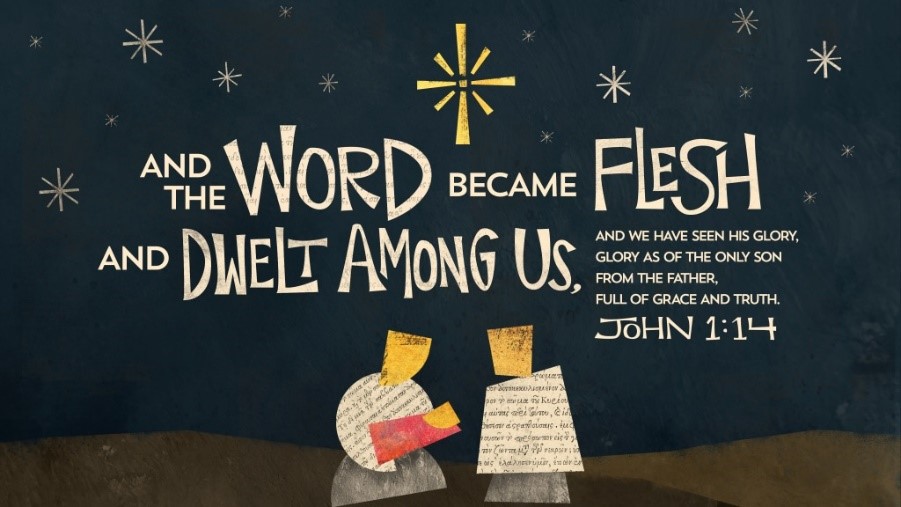
The light shines in the darkness, and the darkness did not overcome it. There was a man sent from God, whose name was John. He came as a witness to testify to the light, so that all might believe through him. He himself was not the light, but he came to testify to the light. The true light, which enlightens everyone, was coming into the world. He was in the world, and the world came into being through him; yet the world did not know him. He came to what was his own, and his own people did not accept him. But to all who received him, who believed in his name, he gave power to become children of God, who were born, not of blood or of the will of the flesh or of the will of man, but of God. And the Word became flesh and lived among us, and we have seen his glory, the glory as of a father’s only son, full of grace and truth.

(John testified to him and cried out, “This was he of whom I said, ‘He who comes after me ranks ahead of me because he was before me.’”) From his fullness we have all received, grace upon grace. The law indeed was given through Moses; grace and truth came through Jesus Christ. No one has ever seen God. It is God the only Son, who is close to the Father’s heart, who has made him known.


Bible Readings for December 29, 2020

Let's read the Bible together in the next year. Today our passages Zechariah 14:1-21; Revelation 20:1-15; Psalm 148:1-14; and Proverbs 31:8-9. The readings are from The Message by Eugene H. Peterson. 


Zechariah 14:1-21 (The Message)


Zechariah 14

The Day Is Coming

 1-2 Note well: God's Judgment Day is on the way: "Plunder will be piled high and handed out.
I'm bringing all the godless nations
   to war against Jerusalem—
Houses plundered,
   women raped,
Half the city taken into exile,
   the other half left behind."  3-5But then God will march out against the godless nations and fight— a great war! That's the Day he'll take his stand on the Mount of Olives, facing Jerusalem from the east. The Mount of Olives will be split right down the middle, from east to west, leaving a wide valley. Half the mountain will shift north, the other half south. Then you will run for your lives down the valley, your escape route that will take you all the way to Azal. You'll run for your lives, just as you ran on the day of the great earthquake in the days of Uzziah, king of Judah. Then my God will arrive and all the holy angels with him.
 6-7What a Day that will be! No more cold nights—in fact, no more nights! The Day is coming—the timing is God's—when it will be continuous day. Every evening will be a fresh morning.
 8What a Day that will be! Fresh flowing rivers out of Jerusalem, half to the eastern sea, half to the western sea, flowing year-round, summer and winter!
 9God will be king over all the earth, one God and only one. What a Day that will be!
 10-11The land will stretch out spaciously around Jerusalem—to Geba in the north and Rimmon in the south, with Jerusalem towering at the center, and the commanding city gates—Gate of Benjamin to First Gate to Corner Gate to Hananel Tower to the Royal Winery—ringing the city full of people. Never again will Jerusalem be totally destroyed. From now on it will be a safe city.
 12-14But this is what will happen to all who fought against Jerusalem: God will visit them with a terrible plague. People's flesh will rot off their bones while they are walking around; their eyes will rot in their sockets and their tongues in their mouths; people will be dying on their feet! Mass hysteria when that happens—total panic! Fellow soldiers fighting and killing each other—holy terror! And then Judah will jump into the fray!
 14-15Treasures from all the nations will be piled high—gold, silver, the latest fashions. The plague will also hit the animals—horses, mules, camels, donkeys. Everything alive in the military camps will be hit by the plague.
 16-19All the survivors from the godless nations that fought against Jerusalem will travel to Jerusalem every year to worship the King, God-of-the-Angel-Armies, and celebrate the Feast of Booths. If any of these survivors fail to make the annual pilgrimage to Jerusalem to worship the King, God-of-the-Angel-Armies, there will be no rain. If the Egyptians don't make the pilgrimage and worship, there will be no rain for them. Every nation that does not go up to celebrate the Feast of Booths will be hit with the plague. Egypt and any other nation that does not make pilgrimage to celebrate the Feast of Booths gets punished.
 20-21On that Day, the Big Day, all the horses' harness bells will be inscribed "Holy to God." The cooking pots in the Temple of God will be as sacred as chalices and plates on the altar. In fact, all the pots and pans in all the kitchens of Jerusalem and Judah will be holy to God-of-the-Angel-Armies. People who come to worship, preparing meals and sacrifices, will use them. On that Big Day there will be no buying or selling in the Temple of God-of-the-Angel-Armies.


Revelation 20:1-15 (The Message)


Revelation 20

A Thousand Years

 1-3I saw an Angel descending out of Heaven. He carried the key to the Abyss and a chain—a huge chain. He grabbed the Dragon, that old Snake—the very Devil, Satan himself!—chained him up for a thousand years, dumped him into the Abyss, slammed it shut and sealed it tight. No more trouble out of him, deceiving the nations—until the thousand years are up. After that he has to be let loose briefly.  4-6I saw thrones. Those put in charge of judgment sat on the thrones. I also saw the souls of those beheaded because of their witness to Jesus and the Word of God, who refused to worship either the Beast or his image, refused to take his mark on forehead or hand—they lived and reigned with Christ for a thousand years! The rest of the dead did not live until the thousand years were up. This is the first resurrection—and those involved most blessed, most holy. No second death for them! They're priests of God and Christ; they'll reign with him a thousand years.
 7-10When the thousand years are up, Satan will be let loose from his cell, and will launch again his old work of deceiving the nations, searching out victims in every nook and cranny of earth, even Gog and Magog! He'll talk them into going to war and will gather a huge army, millions strong. They'll stream across the earth, surround and lay siege to the camp of God's holy people, the Beloved City. They'll no sooner get there than fire will pour out of Heaven and burn them up. The Devil who deceived them will be hurled into Lake Fire and Brimstone, joining the Beast and False Prophet, the three in torment around the clock for ages without end. 

Judgment

 11-15I saw a Great White Throne and the One Enthroned. Nothing could stand before or against the Presence, nothing in Heaven, nothing on earth. And then I saw all the dead, great and small, standing there—before the Throne! And books were opened. Then another book was opened: the Book of Life. The dead were judged by what was written in the books, by the way they had lived. Sea released its dead, Death and Hell turned in their dead. Each man and woman was judged by the way he or she had lived. Then Death and Hell were hurled into Lake Fire. This is the second death—Lake Fire. Anyone whose name was not found inscribed in the Book of Life was hurled into Lake Fire. 


Psalm 148:1-14 (The Message)


Psalm 148


    Hallelujah! Praise God from heaven,
      praise him from the mountaintops;
   Praise him, all you his angels,
      praise him, all you his warriors,
   Praise him, sun and moon,
      praise him, you morning stars;
   Praise him, high heaven,
      praise him, heavenly rain clouds;
   Praise, oh let them praise the name of God—
      he spoke the word, and there they were!

 6 He set them in place
      from all time to eternity;
   He gave his orders,
      and that's it!

 7-12 Praise God from earth,
      you sea dragons, you fathomless ocean deeps;
   Fire and hail, snow and ice,
      hurricanes obeying his orders;
   Mountains and all hills,
      apple orchards and cedar forests;
   Wild beasts and herds of cattle,
      snakes, and birds in flight;
   Earth's kings and all races,
      leaders and important people,
   Robust men and women in their prime,
      and yes, graybeards and little children.

 13-14 Let them praise the name of God—
      it's the only Name worth praising.
   His radiance exceeds anything in earth and sky;
      he's built a monument—his very own people! 
   Praise from all who love God!
      Israel's children, intimate friends of God.
   Hallelujah!


Feeding on Christ Preaching the Proverbs - Feeding on Christ

Proverbs 31:8-9 (The Message)


 8-9 "Speak up for the people who have no voice,
   for the rights of all the down-and-outers.
Speak out for justice!
   Stand up for the poor and destitute!"


Thought for the Day

“Jesus said to his disciples, 'Don't be worried! Have faith in God and have faith in me. There are many rooms in my Father's house. I wouldn't tell you this, unless it was true. I am going there to prepare a place for each of you. After I have done this, I will come back and take you with me. Then we will be together.'” (John 14:1-3 - Contemporary English Version) We don't have to wait to live in fellowship with Jesus Christ; he's prepared a place where we can experience his presence right now. You see, in his church, we can be surrounded by his grace and by his love


Quote for the Day

English missionary to China sent by the Society for the Propagation of the Gospel (SPG), Roland Allen wrote, “The Spirit is Love expressed towards man as redeeming love, and the Spirit is truth, and the Spirit is the Holy Spirit. Redemption is inconceivable without truth and holiness.”


A Joke for Today

Sometimes women are overly suspicious of their husbands.

When Adam stayed out very late for a few nights, Eve became upset. "You're running around with other women," she charged.

"You're being unreasonable," Adam responded. "You're the only woman on earth."

The quarrel continued until Adam fell asleep, only to be awakened by someone poking him in the chest. It was Eve.

"What do you think you're doing?" Adam demanded.

"Counting your ribs," said Eve.


A Prayer Request

As Christians, we can offer specific daily prayers for our community, nation and world. Below is the need that we're laying before God today.

That families would read their Bible and attend worship services together.

Looking into the lectionary — 2nd Sunday of Christmas

John 1:(1-9), 10-18 — January 3, 2021
2nd Sunday of Christmas
If John’s majestic prologue is a summary of the whole Gospel, verse 12 is its synopsis of discipleship: “But to all who received him, who believed in his name, he gave power to become children of God.”
I find two aspects of this verse particularly striking: John’s understanding of “believing” and of “power to become the children of God.” As for the first, it is well worth noting that John never uses the noun “faith” or “belief” (pistis in Greek), but always and only the verb “to believe” (pisteuein) — a whopping 98 times. Thus faith is always an active matter that entails personal involvement with and allegiance to Jesus, trust and intimacy. As Robert Kysar puts it in “John, the Maverick Gospel,” faith is not something that one has; rather, “faith as a verb means that believing is a decision made once only to have to be made over and over again, or a gift accepted not once but again and again. Faith is a continuing dynamic, not a state of being.” 

This dynamic is also captured in a grammatical penchant unique to the fourth Gospel, surfacing 36 times (as in John 1:12): a tendency to speak (translating literally) of “believing into Jesus” (utilizing the Greek preposition eis). In common parlance, when we speak of being “into” something or someone, we imply commitment, investment, passion. This is the kind of faith/believing of which John speaks. It involves deep personal engagement with and allegiance to Jesus, entailing trust and intimacy. As we enter ever more deeply into relationship with him, we enter into the communion that he shares with God, thereby participating in the very life of God. So in the Gospel of John, discipleship entails not only “following” but also “abiding” with Jesus — another key concept central to the life of discipleship.  As Jesus says in John 15:4, “Abide in me as I abide in you.” Abiding entails stick-to-it-iveness — it means remaining, staying, “hanging out” with Jesus, taking up residence with him, observing and sharing his life. 

On a hiking vacation in the Grand Tetons, my wife and I had a memorable encounter with a bull moose that captured, metaphorically at least, a bit of the dynamic, active, abiding nature of discipleship – the “becoming” children of God – of which John speaks. To rest weary legs, we took a day off for a raft tour down the Snake River. Along the way, our guide noticed an enormous bull moose sitting in the high grass on the banks of the river, chewing the cud — chewing partially-digested food. The guide explained that after eating so many leaves and twigs, a moose will sit down and munch on it for a long while, absorbing the nutrients into its digestive system.  It was an amazing sight — and even more amazing was the sound, as that moose was quite audibly chomping!  

It brought to mind words of Jesus in John 6:56 – “Those who eat my flesh and drink my blood abide in me, and I in them” – for John uses graphic language of eating that entails active (even audible) chomping, gnawing, munching and crunching, much like an animal chews the cud. The eucharistic implications are unmistakable and are a means by which we abide in Jesus and share his life, for as theologian Norman Wirzba has noted in “Food and Faith: A Theology of Eating,” the idea of “eating Jesus” means taking his life inside of us, making it part of us, so that it transforms us from within. It involves coming “under the influence of his instruction and his way of being in the world. It is to submit to and let one’s own life be guided by the concerns and priorities that define him.” Discipleship is about absorbing (indeed, digesting) a way of life. It thus requires attentiveness and time in Jesus’ company – “hanging out” with him, following him into the world, and also into the heart of God, where he abides (John 1:18).  

The second thing I would flag for attention in John 1:12 is that the active, dynamic, abiding process of “believing” in(to) Jesus also entails “power”: “But to all who received him, who believed in his name, he gave power to become children of God.” I find it striking that John uses the word “power” (exousia in Greek) in conjunction with becoming children of God — a word that could also (and often is) translated as “authority.” Many people prefer this translation, finding “power” language a stumbling block. Indeed, in the practice of community organizing, we talk a lot about “power,” and over the years I have noticed that church folk often object to any positive use of the term. The reason often given is that they have seen too much abuse of power — so much so that abuse and power seem almost synonymous. However, community organizing teaches a positive use of power, in the sense of “power with others” (rather than over others) — in other words, a relational power. Relational power is not only the ability to resist injustice and violence, but also the means to achieve a common good or goal by working together. Thus I appreciate John’s association of power with the process of becoming the children of God. In John’s view, becoming children of God brings to life a new relationship with God in Christ and with each other, as brothers and sisters in Christ (John 1:12; 20:17). And these new relationships do involve power — the relational power of mutual love articulated in the love commandment, so central to John’s understanding of discipleship and the life of the church.

Some may wonder whether “love” can be commanded — especially Westerners who tend to associate the language of love with feelings. We may need reminding that in the biblical perspective, love is not something you feel, but something you do. Love entails acting on behalf of the well-being of another (sometimes despite how you feel) — thus it can be commanded. Over time, one’s feelings may catch up with one’s actions, but acting on behalf of the well-being of others, over and over, is a good definition of what it means to become God’s own children, by the power of God at work in our lives.

In sum, on the second Sunday of Christmas, John 1 provides rich food for thought about the gift of the incarnate Word and the new possibilities it opens up in our lives: “to all who received him, who believed in his name, he gave power to become children of God.” By believing “into” him, abiding in his presence and absorbing his life, we are ever in the process of being formed by the power of the Spirit to become the God’s own children — for one another and for our world.

This week:
  1. What do you think of the notion of “believing” as a verb — of faith as a dynamic process of becoming intimate with Jesus and sharing his life? Of being “into” him?
  2. What are some of the practical ways in which we “hang out” with Jesus, abide or remain in his presence, thereby entering more deeply into relationship with him and the very life of God?
  3. What does the language of “eating Jesus,” of taking his life into your own, contribute to your reflection on eucharistic practice?
  4. Do you prefer the language of “power” or “authority” in John 1:12? Why?
  5. What do you think of the connection in John 1:12 between power and becoming children of God?   
  6. What do you think of the biblical understanding of love as something you do (rather than something you feel)? What role does love play in your understanding of what it means for us to be children of God?
John Rutter's new choral piece, “Joseph’s Carol,” was released Dec. 18. Rob Hoch considers how it commemorates the work of the Oxford scientists who designed a vaccine for COVID-19 and the messages of such hymns for these times.

Expecting during the unexpected
Jack: A novel
A prayer for hugs again
Facebook ‌ Twitter ‌ Pinterest ‌ Instagram ‌

The Presbyterian Outlook | 1 N. 5th St., Suite 500, Richmond, VA 23219